

This week I kept noticing the same move, in different industries, at different scales: challengers choosing to compete on the incumbent’s own ground instead of trying to build a new one. A toy on the FIFA stage. An SUV at the Nürburgring. A retailer opening a gallery on the Bund. None of these are accidental choices. They’re all answering the same question — on whose terms does something get taken seriously?
MINISO Opens a Gallery
MINISO opened an art gallery inside a century-old government building on Shanghai’s Bund — not a brand activation, not a pop-up, but a permanent institution curated to professional museum standards. The debut show features RYOL, an Indonesian artist born in 1993, signed as MINISO’s first globally exclusive talent. The building is the former city hall of Shanghai.
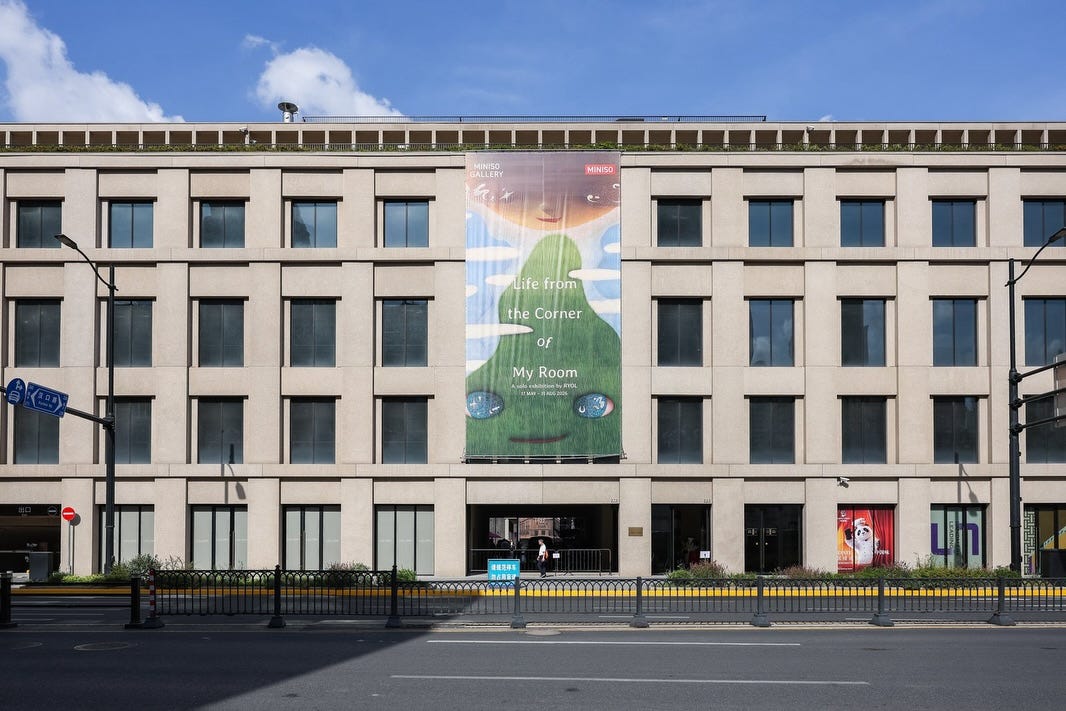
The traditional gallery is a gatekeeping system. A small circle of curators, collectors, and auction houses decides who gets seen and what a career looks like. That system is also under pressure — global gallery revenues have been slowing as costs rise and young artists find other channels. MINISO is building the alternative: a platform that connects artists directly to 8,400 storefronts in 112 countries, with real commercial infrastructure behind it. The gallery isn’t the product. It’s the proof of commitment — a signal to artists that this time it’s a real investment, not a collab opportunity. Paris and New York are next on the map.
Labubu at the World Cup
Lisa headlines the 2026 FIFA World Cup opening ceremony at SoFi Stadium in Los Angeles on June 12. Her new single “Goals” — with Brazil’s Anitta and Nigeria’s Rema — features Labubu four times in the official MV. Pop Mart entered as a licensed merchandise partner, reportedly for around $50 million, a fraction of what top-tier FIFA sponsors pay. First Chinese toy IP on a FIFA stage.

What makes this more interesting than a standard sponsorship story is the relationship behind it. Lisa was widely credited with igniting Labubu’s global profile in the first place — she wore it before the brand was famous outside China. This isn’t a brand buying a celebrity endorsement. It’s a mutual return on earlier trust. A Thai pop star and a Chinese toy IP arrived at the world’s largest sporting event together, each having amplified the other to get there. That’s a new kind of cultural pathway — and it didn’t run through any of the usual gatekeepers.
Richemont Bets on China, Wins on Jewelry
Richemont posted full-year FY2026 results that most luxury peers would find uncomfortable to read: fixed-rate revenue up 11% to €22.4 billion, with the jewelry division — Cartier and Van Cleef — up 14%, running at a 30.5% operating margin. In a year when LVMH grew 1% and Hermès actually declined, Richemont is doing something differently.
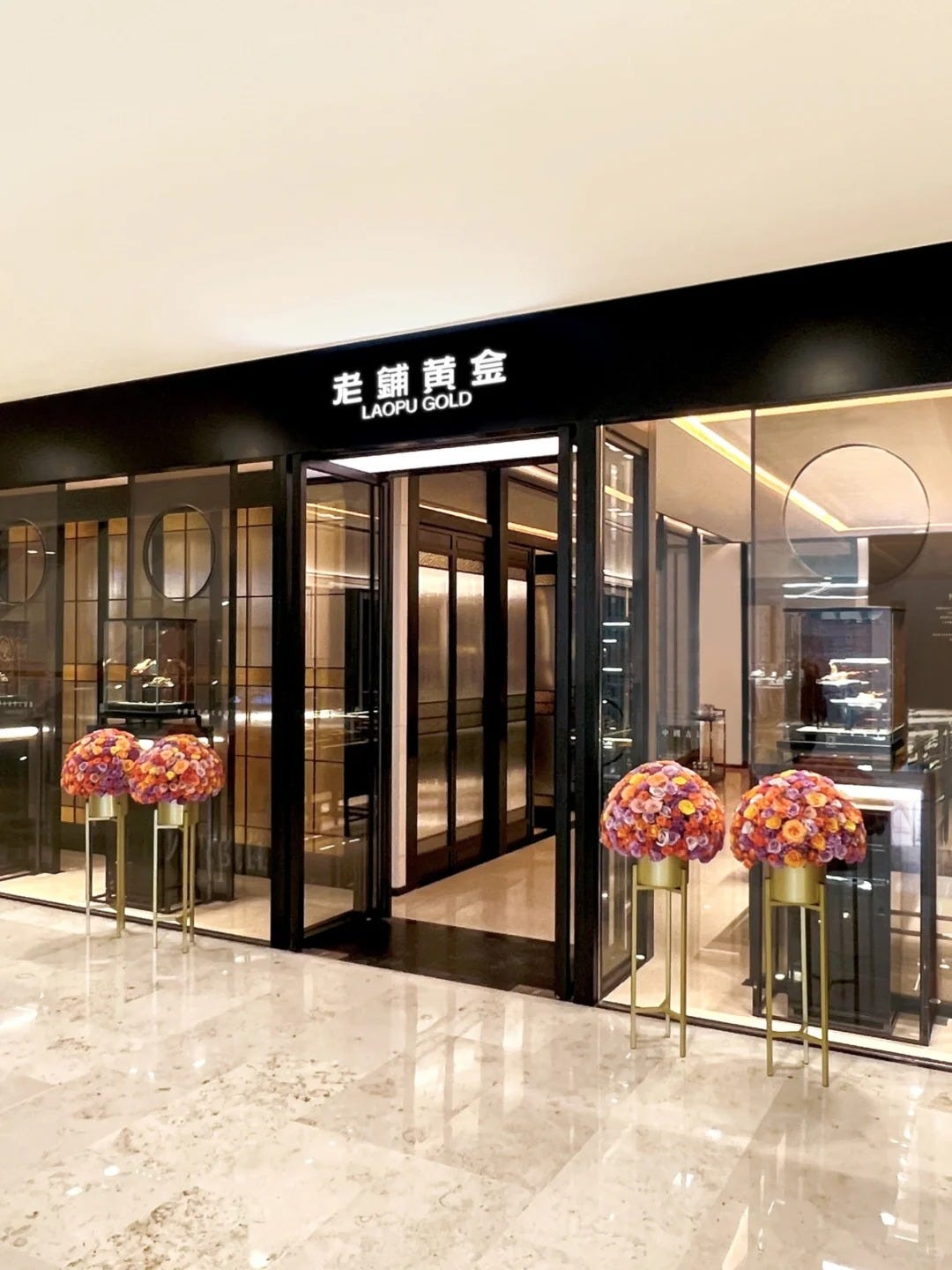
The most revealing moment in the earnings call wasn’t a number. It was CEO Nicolas Bos citing Laopu Gold — a Chinese gold jewelry brand — as evidence that Chinese consumers are actively rewarding local innovation and creativity. He didn’t frame it as a threat. He framed it as a lesson. Chairman Johann Rupert added, separately, that Chinese brands might simply be best run by Chinese people — a graceful acknowledgment that a 150-year-old Swiss group may not hold all the relevant advantages in this market. The takeaway isn’t that luxury is in trouble. It’s that even the winners are now publicly naming their local challengers. When incumbents start citing upstarts in earnings calls, the competitive map has shifted — whether or not anyone is ready to say so directly.
Xiaomi YU7 GT has smashed the SUV record
The YU7 GT just set the Nürburgring lap record for production SUVs, 14 seconds ahead of the Audi RS Q8. The standard YU7 is priced below the Tesla Model Y. Both facts are deliberate.
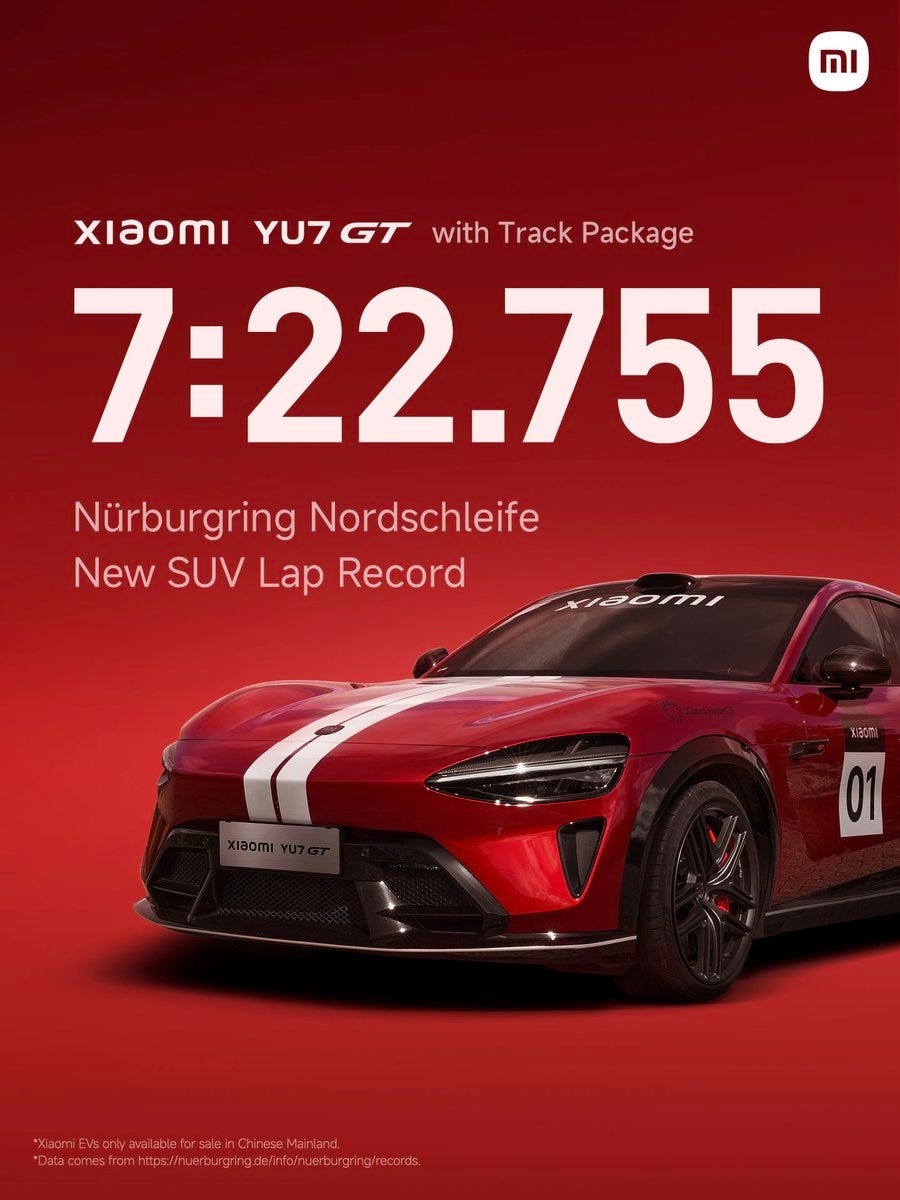
Lei Jun didn’t benchmark the YU7 against its actual competitors — Li Auto, NIO, the other Chinese SUVs fighting in the same price band. He chose Tesla as the price floor and Porsche as the performance ceiling, then positioned Xiaomi between them. Most buyers will never go near a racetrack. That’s not who the record is for. The record is for the mental model — “the fastest production SUV at the most famous circuit in the world, priced below Tesla” is a sentence that travels. The deeper lesson here is about how challengers should compete. You don’t invite the comparison and hope people believe you. You go to the incumbent’s own arena, win there, and let the result speak. Xiaomi didn’t have to run the Nürburgring. That’s exactly why it worked.
Starbucks Starts Selling Clothes
Starbucks just launched a clothing line in China — work vests at $59, hooded jackets at $68, all built around Bearista, its bear mascot that’s been around since 1997. The underlying reason is clear: merchandise and licensing revenue hit $530 million last quarter, up 39%, at a 52.3% margin. That’s higher than selling coffee.
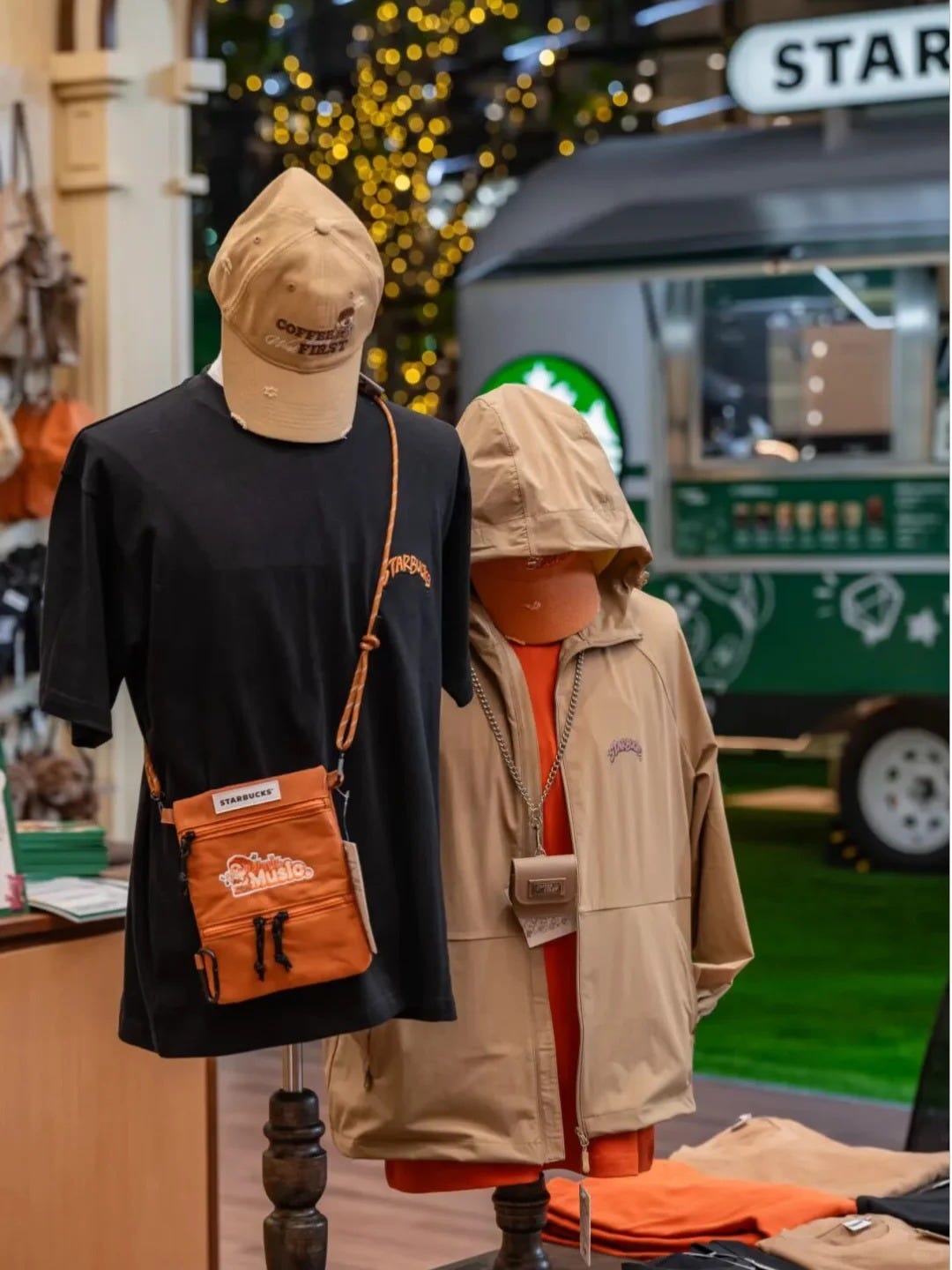
Chinese tea and coffee brands are running the same play at much faster speed. Forty-seven brands executed 240 IP collaborations in 2025. MIXUE’s Snow King is now planning a theme park. M Stand launched 63 products in a year and has pushed into shoes and cosmetics. The beverage is the entry point. The brand is the business. The more interesting point is what this says about reach. The “third space” concept that built Starbucks — the café as a place between home and work — doesn’t mean much to consumers who discovered the brand through a delivery app. A hoodie or a tote is how you exist in someone’s daily life without them ever walking through your door. In an attention-fragmented market, the lifestyle product is the third space. The brands that understand this are competing for cultural presence, not cup count.
McDonald’s x Pop Mart
McDonald’s China ran a Pop Mart collaboration last week — 400,000 Star People toys, $9 each with any meal. Sold out in fifteen minutes. The Potato Star variant was gone in sixty seconds. Even the printed paper tray liners — technically just packaging — started trading on secondhand platforms within hours. A second batch of 350,000 ships on May 30.
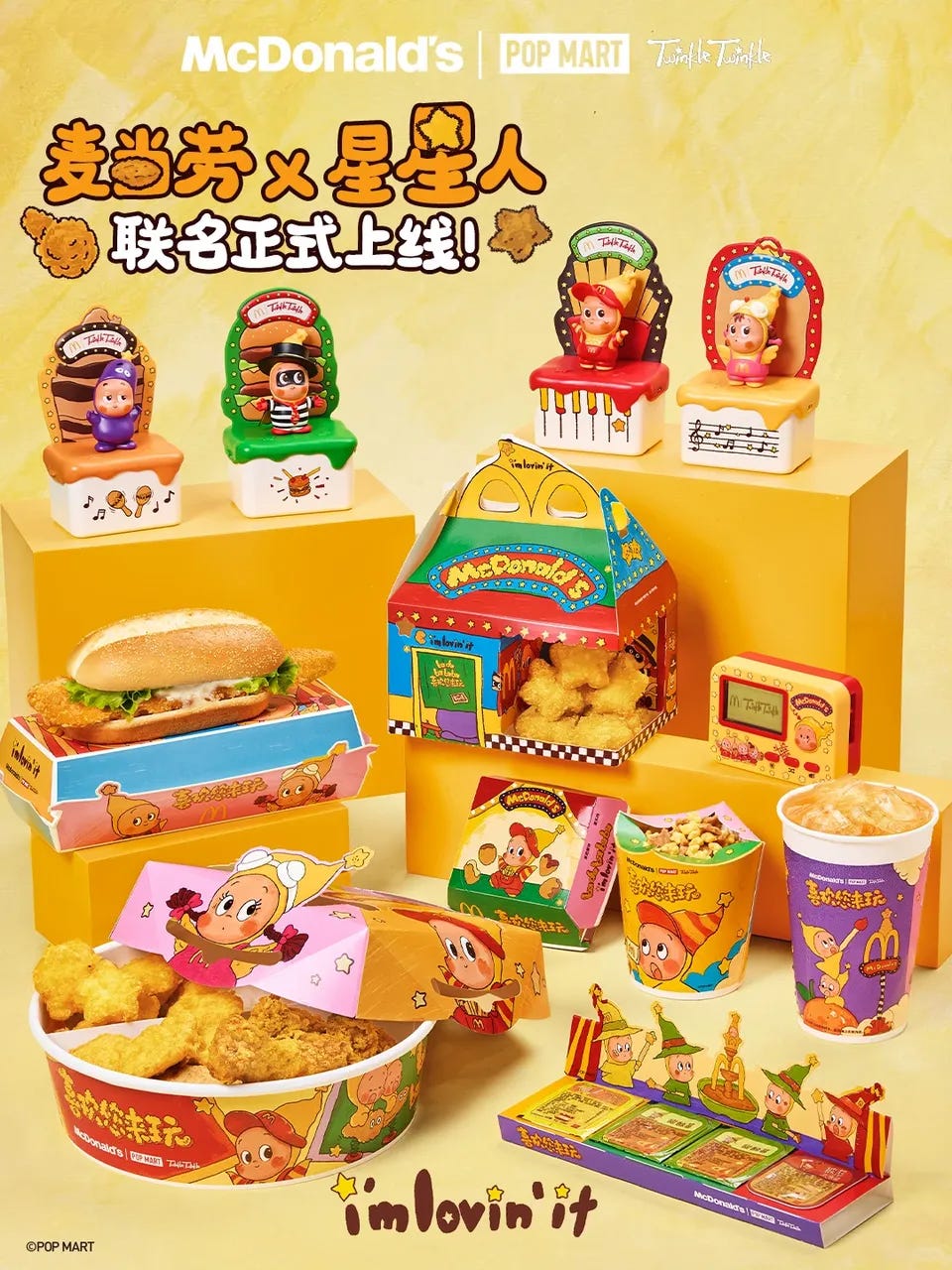
McDonald’s has understood something that most brands in China are still figuring out: the most bankable emotion right now is the permission to not be an adult. The “麦门” devotion — the half-joking, half-sincere loyalty that Chinese consumers express toward the brand — isn’t really about burgers. It’s about a place that has consistently offered stressed, overworked adults an excuse to feel something lighter than their day. Pop Mart’s IP gave McDonald’s better props to do it with. When 400,000 toys disappear in fifteen minutes, it’s not a collab. It’s infrastructure. The brand that can reliably give adults a reason to act like children, at scale, has built something harder to copy than any product feature.
Proya Acquires Flower Knows
Proya, China’s largest domestic beauty group, just moved to take a controlling 51% stake in Flower Knows, a cosmetics brand built around obsessively detailed Rococo-inspired packaging. Total valuation: $417.83 million, a 596% premium over book value. Flower Knows’ 2025 revenue was $251.26 million, with a $41.38 million net profit. Overseas revenue exceeded $29.56 million, growing over 50%, with pricing in European and US markets running 1.5 to 3 times domestic levels. Meanwhile, Proya’s flagship brand declined 10% in 2025.
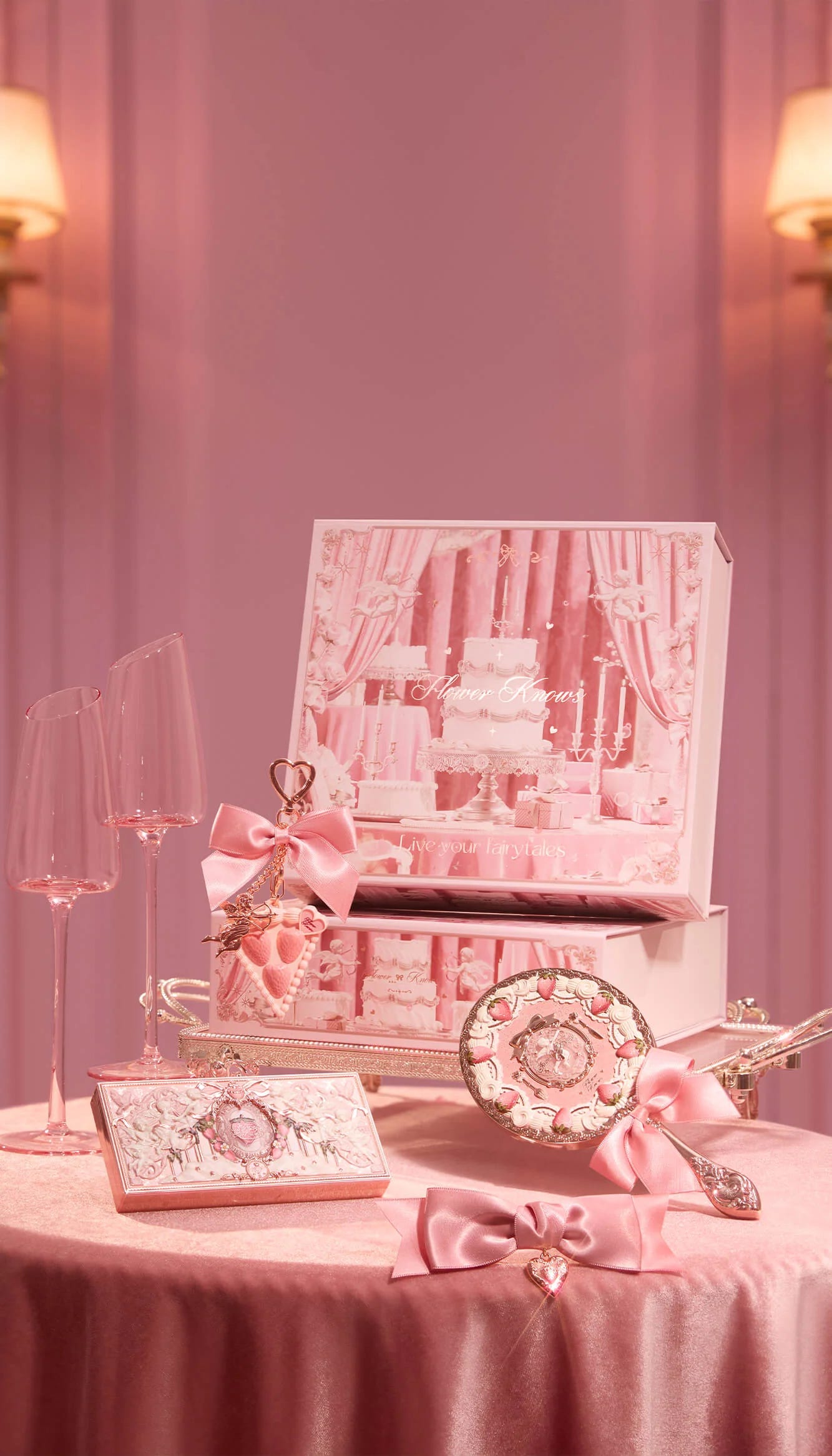
This is the Anta playbook applied to beauty. Anta didn’t become China’s largest sportswear group by outcompeting Nike at its own game — it acquired FILA, then Descente, then Amer Sports, and used its operational infrastructure to scale brands that had already done the hard work of building positioning. Proya is doing the same: instead of building a new brand from scratch to compete in an already crowded market, buy something that has already cracked overseas markets at a premium. Flower Knows won internationally on design, not on heritage or distribution muscle. That’s a newer kind of Chinese export story — and the Anta model suggests it scales.
Airwallex Is Building Real Financial Infrastructure
Airwallex’s founder Jack Zhang published a piece this week laying out a taxonomy of how global payment infrastructure actually works — and why most of what’s sold as “global” isn’t. Three paths: build on crypto rails (real friction, limited reach), aggregate banks and networks with a better interface (fast to launch, but you’re still renting someone else’s pipes), or build your own infrastructure in every jurisdiction where you operate. Airwallex took the third. Licenses in over 50 countries, local teams on the ground, systems built from scratch. For nine years, that looked like the slow path. Then revenue went from $500M to $1B ARR in a single year.

The lesson isn’t unique to fintech. It’s about what “durable” requires in any regulated, trust-sensitive industry. Most platforms in this space are aggregators wearing infrastructure clothes — you can’t see the difference until a payment fails, a license gets revoked, or a rule changes and someone has to absorb the complexity. The companies that built the plumbing themselves can absorb it. The ones that didn’t, pass it to their clients. Slow compounding doesn’t look like much at year three. At year nine, it looks like a moat.
This week’s dispatches had a quiet undercurrent: the old map’s established players are beginning to name their challengers. A Swiss luxury CEO citing a Chinese jewelry startup in an earnings call. A global fast food chain relying on a Chinese toy IP for its biggest marketing moment of the year. That’s not disruption. That’s arrival — and it’s being acknowledged out loud.